West Ham vs Nottingham Forest Football Match Blog Post (January 6th)
Game Recap:
Yesterday we got the chance to witness an amazing and competitive match at the London Stadium
between West Ham and Nottingham Forest. The game started off in favor of the Hammers as they scored an early goal around the 15th minute. They finished out the half ahead, going into the second part of the game feeling confident and encouraged. However, soon enough in the 55th minute, Nottingham’s
Dominguez tied up the game. The rest of the second half was a tough battle with both teams doing
everything they could to pull ahead. The final score of the game ended up being 2-1 with Nottingham
taking the lead in a crucial penalty kick that was scored with 2 mins left of regular time. The home fans were devastated to see their team lose and we could feel their disappointment through the stadium
atmosphere.

Atmosphere:
The atmosphere at last night’s West Ham vs Nottingham Forest match was relentless, but in the
best way. With relegation more likely for the losing side, the stakes of the match were clear from the start
and only grew the already electric atmosphere inside the stadium. From the moment we took our seats, the home fans made it very clear that London Stadium belonged to them. They sang their anthem “I’m
Forever Blowing Bubbles” not just before kickoff but repeatedly throughout the match, each time louder
than the last time. Honestly, the noise never seemed to dip, no matter if West Ham was leading, or at the
end trailing. The crowd definitely seemed just as committed to jeering Forest as they were to lifting their
own side. One especially memorable moment was seeing fans hold up red cards in the stands to protest
West Ham United’s poor management. To us, this was the perfect snapshot of EPL football, deeply loyal,
passionate, and high energy.
Other thoughts:
This was my first time at a professional soccer game and my first time at a non-American
sporting event. I’d been to many baseball and football games in the US, but the West Ham match in the
London Stadium was completely different. The biggest difference I noticed was the lack of production
during the game. In the states, the Jumbotron is placed in the central view of the stadium, ads on
additional screens run through the stadium as well, marketing various products, listing player stats, and
showing live replays of important plays. During this match, they only showed player introductions (of the
home team alone), the regular score board, and a photo of the offsides VAR review. This simplistic
production forced fans to be in the moment of the game and I found it to be a lovely break from the
over-production of American sports.
Student Q&A:
1.) What was your favorite part of the match?
Student: My favorite part of the match was getting to see the fans be so engaged with each play. They
were so vocal about what they were excited about or disappointed in and it was awesome to watch how
passionate they were for their team.
2.) What do you think about the home management not announcing the lineups for the
opposition?
Student: I thought it was very interesting and slightly odd as it would be nice to know who the other
players were. However, I do understand the purpose in this to really reinforce the support for the home
team at their stadium, especially in such an important game.
3.) What do you think the EPL could do to improve the overall experience of the fans?
Student: I think they could obviously make tickets more affordable and accessible because getting tickets
to these games is so difficult and we are lucky that this program provides that for us. I also think that
specifically at London Stadium they should implement replays on the big screens so the fans get a second
chance to see an awesome play, goal, save, etc.
4.) Was it a Penalty?
Student: The call made by the referee to award a penalty for a foul by Areola on Gibbs-White with
minutes remaining in what was a 1-1 was rather controversial, with exasperated fans and players
displaying their upset, whilst Forest players made no appeal to the referee. That aside technically the
penalty awarded was a foul but as West Ham CDM Tomas Soucek remarked, it was a call that shows how
refereeing in the Premier League has become like basketball.
By Bella, Disha, Ethan, John, and Katherine
Football Historian Simon Inglis Blog Post (January 8th)
On Tuesday, January 8th, Sports and Globalization 2026 had the pleasure of learning from and spending time with Simon Inglis. Mr. Inglis is a writer, lecturer, and architectural historian from Birmingham, England. We began the day with a lecture focussed on the history and heritage of football in London.
Simon began by explaining that what we know as football today has not always looked the same. Early versions of football were less formal and quite different than what we play today, with games being played in town squares and school corridors, and the use of hands was not always against the rules. More formal rules and practices were developed, helping football distinguish itself from other sports and allow more formal competitions.
As teams started forming and playing against each other, the game became professional, leading to a need for stadiums. This is of great interest to Simon, who has studied the architecture of these grounds. We learned about how different teams in the London area were founded and where their stadiums were built. Understanding this led us to the main topic of the lecture, history and heritage. Simon explained history as the gathering and interpretation of evidence, which we can look at as facts that have been written down that tell us what happened. Heritage, on the other hand, is what we choose to value from history. In football, heritage can be seen in team colors, club locations, stadiums, and other details of team founding. All of these elements together can help build the identity of a club, connecting supporters from various time periods.
The geography of London adds layers to this topic, as there are many football teams in the area, but finite places for them to exist. Over time, clubs have competed for space, moved grounds, and redesigned stadiums to adapt to the modern game and conditions. By the end of Simon’s lecture, we saw how history and heritage play great roles in football, giving us insight into the identity of the clubs in London.
After our time in the classroom, we were able to take what we learned and see some of how it manifests itself in the city. We started by visiting the site where the Football Association was formed in 1863. This helped us connect our ideas of history to the game itself, and reflect on its importance. We also visited the Arsenal tube station, the only underground stop that is named for a football club.
The next stop on our walking tour was the old Arsenal stadium, which has now been turned into flats. Though construction had been done, it was still clear how the stadium used to look, with four walls of stands (now the flats) surrounding the pitch, which is now a garden. Just up the road from the old Arsenal stadium stands the new one, which is significantly more grand. We learned that the new stadium was built because the old one simply could not hold enough people for the demand they were getting. Additionally, we had the opportunity to speak with locals about the stadiums. One woman told us that she doesn’t like the changes, because the new flats are not pleasing to the eye and that many shops nearby have gone out of business. This was very interesting to us, as it brought to light issues that we had not considered before.
Finally, we visited the new stadium, where we walked around the outside and admired various connections with the history and heritage of the club. Statues, team colors, and signs were just some of the interesting points that we learned about. Connecting our classroom learning to the important people in the club’s history and its logo was very powerful, as we saw which parts of the team’s past were best remembered and of highest importance.
We had a wonderful time learning from Simon Inglis about football in London and the history and heritage of clubs, and we will remember his teachings when we watch games and visit stadiums in the future.
By Josh Madigan
Aston Villa vs Tottenham FA Cup, Round 3 Blog Post (January 11th)
On Saturday evening, our group traveled to North London to watch Aston Villa at
Tottenham Hotspur in the FA Cup third round match at 5:45pm. We made our way down to
Tottenham Hotspur Stadium using both the Underground and Overground train systems, with
some students arriving early to catch a pre-match meal and explore the surrounding area. The
commute took 45 minutes from our flats in Camden and formed a key part of the match day
experience. Fans from both clubs filled the train cars, allowing us to see the energy and
atmosphere build before kickoff. The Villa fans were outspoken and incredibly passionate,
showing off their popular chants on the trip. One of these chants praised their midfielder John
McGinn, the “Scottish Zidane,” which proved to be a fair assessment of his skills on the pitch.
When we arrived at the stadium, it was first noticeable how well it was integrated into the
community. The structure was surrounded by houses and small business, making it feel as though
it was ingrained in the identity of the area. The stadium itself was finished in 2019, and is one of
the most modern in the world. The architecture is impressive and stands out among brick houses
and flats nearby. As we approached, the chants grew louder as more and more people joined in.
Compared to a depressed West Ham fanbase, unsatisfied with their ill-suited temporary stadium,
the atmosphere was electric (despite Spurs’ disappointing run of form as of late).
Our seats were located in the lower tier of the North Stand, directly behind the goal and
right next to the away fans section. While all three goals scored were on the other end, our view
was fantastic and as exciting as anywhere else in the stadium. The Aston Villa supporters
provided ample entertainment throughout. The away stand remained standing and clapping for
the entirety of the match (“all day” as they reminded the Tottenham supporters with their chants),
and many obscenities were thrown between supporters. Those interactions though were a
significant part of soccer culture and the overall experience. Some of their most creative chants
included “He’s an Arsenal fan Thomas Frank,” referring to the Spurs manager caught drinking
out of an Arsenal mug (the club’s archrival), and “When the Spurs Go Marching In” sung by
over 50,000 people.
Aston Villa dominated the match in the first half, netting two goals in front of the home
supporters and maintaining a large percentage of the possession. Emiliano Buendia and Morgan
Rogers found themselves on the scoresheet and Villa looked poised to run away with the lead.
Spurs’ ailments only grew in the 31st minute as Richarlison came off with a pulled hamstring,
adding another big name to an already large list of injured players. Deflated and disgruntled with
their team’s inability to hold onto the ball, Spurs fans filled the air with boos and whistles as the
halftime whistle blew.
Despite the disappointing first half, the Lilywhites returned to the pitch with energy and a
sense of urgency. Wilson Odobert found the back of the net for the home side, filling the stadium
with a much-needed sense of hope. However, Spurs’ attacking efforts were not enough to close
the gap, and Aston Villa maintained their lead with help from a pair of chalked-off Spurs goals.
The victory maintained a good run of form for the Claret and Blue, seeing them into the next
round of the FA Cup. For Tottenham Hotspur, however, the result added to a string of poor
performances at home in recent months. Pressure continues to pile on Spurs manager Thomas
Frank, who has been unable to find a groove at the club since his arrival in June. After settling
their differences between the stanchions, the cheery Villa and agitated Spurs supporters made
their way to the trains, eager to head home on such a brisk London night.
By Hays, Liam, Jaxon, Carson, Luke
WSL Tottenham Hotspur vs Leicester City Match Blog Post (January 13th)

On our third game excursion, we had the opportunity to watch Tottenham Hotspur Women take on
Leicester City Women at Brisbane Road, the home of Leyton Orient FC. The smaller stadium made the
experience feel more personal and gave us a great view of the action throughout the match, especially
when compared to the Tottenham vs. Villa game we attended the day before.
The difference in atmosphere between the two matches was easy to notice. While the Tottenham vs. Villa match was played in a packed and bigger stadium, the women’s match used only one side of the ground for fans. Even so, the energy was still there, with Spurs supporters chanting consistently throughout the game and creating a lively matchday atmosphere. The recorded match attendance was 1384.

The first half was exciting, with plenty of close chances from both teams. Spurs kept the pressure on early and were rewarded with an own goal from a corner kick that put them up 1–0 in the 40th minute.
Interestingly, the player who scored the own goal, Ashleigh Neville, was a former Spurs player making
her debut for Leicester. The energy in the stands picked up after the goal, and Tottenham looked confident heading into the break.

At half-time, Josh got his first taste of UK football culture, as he and several classmates took part in a 1v1
challenge against a freestyle footballer. It was a fun moment that added to the overall matchday
atmosphere and got the crowd involved.
The second half slowed down a bit but still had some quality moments. There were a couple of nice runs
and some really clean passing from the Spurs, but missed finishes kept the score the same. Leicester
stayed organized, which made it tough for Tottenham to find a second goal.

After a hard-fought 90 minutes plus stoppage time, Tottenham Hotspur Women started the new year with a 1-0 victory over Leicester City Women in today’s Women’s Super League clash at Brisbane Road. Our Woman of the Match was #23 Maika Hamano, who came on as a substitute in the second half, making her debut for the club. She looked dangerous when she came on, driving at the back line with the ball, and playing dangerous forward passes between the Leicester defense. Tottenham extended their unbeaten run at Brisbane Road to six games in all competitions. The women will now prepare for their next match, an FA Cup match in the 4th round, also interestingly against Leicester City.

After the game, the lads picked up some steaming crispy fish and chips before a short tube ride home.
Some had eyes bigger than their stomachs for these rather huge versions of the British staple!
By Angel Mendez Lopez, Josh Zebrack, Dash Schwab, Sam Johansen, Myles Swisher
“Dear England” Play Blog Post (January 14th)
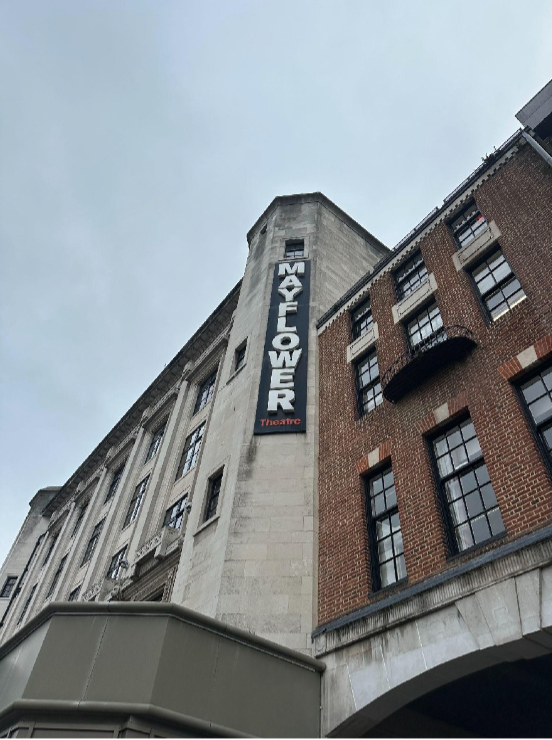
On Wednesday we as a class took a trip down to Southampton to watch Dear England, a play
by James Graham and Rupert Gould, concentrating on Gareth Southgate’s time as England manager. The play started off with a brief recap of England’s terrible history of managers and performances in
major tournaments, including a loss to Iceland in the 2014 Euros and the 1-game term for Big Sam
Allardyce. Out of the chaos emerged Gareth Southgate, a former England player who had missed the crucial penalty in the 1996 Euros semi-final against Germany, and at the time U21 coach
emerged as what was meant to be a temporary appointment. Yet that temporary appointment
quickly turned into a full time appointment for Southgate, who sought to transform England
before the start of the 2018 World Cup in Russia. We were somewhat surprised to learn that
playwrights focused largely on the role of psychology, with Southgate attempting to address
England’s persistent penalty taking struggles and, with the help of Pippa Grange, to find out what
is wrong with England. For the purposes of the play some things are adjusted, the lack of the loss
against Belgium in 2018 in the group stage and the constant criticism towards Southgate over
tactical decisions, the play did its best to highlight the transformational role of Southgate’s tenure
and his unparalleled record with England where over four major tournaments England reached 2
finals, 1 semi final, and 1 quarter final.
It is important to note as we had to research before watching the film we discovered when
initially produced the play ended with England winning the 2024 Euros, the adapted ending
managed to tie the story neatly together by explaining how sometimes the stars won’t align no
matter the efforts you take, and how England fans and players have gotten better at learning how
to lose and to support one another, in light of the experiences of Rashford, Sancho, and Saka
after the penalty loss to Italy in the 2020 Euros.
While attending theater productions may not be high on the list of most athletes’ favorite
things to do, Dear England offers a rarely seen side of sports that any competitive player can
identify with. In the world of sports, it is standard practice to be hypercritical of all aspects of a
player’s on field performace: how fast did they run? How many goals did they score? How many
did they miss? These types of questions dominate our discussions about player and team quality.
James Graham and Rupert Gould’s core message flips this narrative, using an intentionally stark
set design and intimate dialogue to highlight the pressures athletes face, all while challenging the
audience’s understanding of masculinity in sports.
The production starts with a young Gareth Southgate standing center stage, lining up to
take his infamous 96’ penalty kick. Young Southgate stands alone in the spotlight while his older
self watches from a distance. The tension is palpable as the audience knows we’re watching a
man re-live one of the most traumatic experiences a player could face in their career. Throughout
the play, we revisit the penalty spot, and with each iteration of this stressful moment, more and
more people join the stage. This subtle difference shows the audience how Southgate attempts to
protect his players from experiencing the same traumatic isolation he experienced. While we
later see future England players also miss game-winning penalties, all are instantly consoled by
their teammates and manager.
After the initial penalty, Southgate’s opening dialogues take place in front of lockers lined
with past versions of the England national team jersey. As Gareth Southgate is convinced to take
the job, the audience can feel the weight of England’s football team’s history weighing down on
him. Later on, we see the old jerseys replaced by kits from current players, symbolizing the shift
in Southgate’s mindset from trying to reconcile the past to embracing a more optimistic future.
The idea of pressure and how we handle it as people and players is ever-present in the
play, and each instance it is addressed with open and honest discussion, challenging traditional
notions of masculinity in sports. Through Pippa Grange and Gareth Southgate’s dialogue, James
Graham dispels the idea that professional athletes are supposed to set their emotions aside and
perform regardless of their mental state.

By John Hines-Shah
Aston Villa vs. Everton Match Blog Post (January 18th)

On Sunday, January 18th, the sports and globe team had the privilege of travelling to Birmingham to watch Aston Villa take on Everton at Villa Park which holds 43,205 fans. At the time of the fixture, Aston Villa was 3rd in the Premier League while Everton was sitting in 12th. The match ended 1-0 to Everton, marking the 3rd home Premier League match at which we have observed the home team lose.

We began our day by meeting at Euston station promptly at 10:30am. From there we started our long journey to Birmingham. Our train left at 10:45am and took around 2 hours to arrive at Birmingham. On the train I worked on my presentation for class on Tuesday while some of my peers chatted about soccer and shared their excitement for the game. After our train arrived, we had some free time in Birmingham
before our shorter train departed for Villa Park. Some of my friends and I explored a nearby mall where we found our favorite stores and some good food. We did some quick shopping, mostly looking for good
deals. We found an Adidas x Aston Villa store and we were tempted by some cool Villa merchandise, but none of my friends are Villa fans so we moved on. The next train we took was to Villa Park and the ride was only around 15 minutes. When we got close to the stadium, you could see it out the window of the train. On that ride, some of my friends and I played games, but the train was packed with Villa fans. When we arrived at the station, it was a short walk to the park in the rain, but we made our way through the stadium and to our seats. There were so many stairs to climb to reach the seats, but the view was much better than the Olympic stadium that West Ham is playing in. We were much closer to the action where we could see our favorite players such as Jack Grealish of Everton and Morgan Rogers and Ollie Watkins of Aston Villa. Before kickoff, there was loud music and chanting as the players came out. The
stadium crew also set up fireworks and flamethrowers that added to the walkout spectacle. Everton had a solid early chance when Pickford sent a long ball forward and they hit the post within 30 seconds of kickoff, but the play dulled slightly after that. Villa definitely dominated the game. Villa held 63% of possession and out shot Everton 18 to 9. Villa completed almost double the number of passes of Everton and recorded less fouls and more corners, but their efforts were in vain. Everton scored during the
beginning of the second half when the Villa center back took a terrible touch, and Everton capitalized by stealing the ball and quickly taking a shot. The first one was blocked, but the rebound fell to an Everton player and while Emilio Martinez did everything to stop the shot, it went in after deflection. The Everton fans erupted in cheer and the Villa fans went silent. Villa did not play defeated however. A few subs and cheers from the crowd invigorated more attack, but Everton cleverly and efficiently wasted time and were able to hold on to the lead. Leaving the stadium after the game was hectic because all the fans were exiting at the same time, but we made it to the correct platform and squeezed on the train back to Birmingham station. During the ride, the Everton fans sang songs and chanted loudly. We got
lucky, or unlucky depending on how you look at it, to be next to a bunch of rowdy Everton fans who taught us many chants. They found out that we were from the USA and started chanting about Tim Howard, an American goalkeeper that played for Everton. We got back to Birmingham station and found a quick dinner before boarding the train back to Euston.
Overall, the experience and whole day adventure was something everyone enjoyed. Growing up watching and hearing about Premier League games makes actually attending a game so much more special. We can’t wait to see future games and hopefully see a home side win.
By Willan Shrock
Street Soccer London Blog Post (January 18th)

Our group had the privilege of attending a Street Soccer London session at Black Prince Trust in Lambeth earlier this week. When we arrived, we were impressed by the facility and everything it offered. The hub included multiple small football fields, a basketball court, and a boxing gym, showing how the space supports a wide range of physical activities for the community. Since we arrived at Street Soccer’s London grounds an hour before our scheduled playing time, we got to talk with Frankie, the manager of the London operations. Frankie shared his story with us; growing up in Sudan under torturous warzone conditions, braving the Sahara desert to escape his unsafe home and go to Libya, facing the Mediterranean voyage on a packed raft, learning Italian in an overcrowded refugee camp, finding people to help him get to France, preventing fights and trying to find somewhere to sleep in Calais, again facing the waves to cross the English channel, and finally settling in London, getting his papers and Bachelor’s degree, and rising through the ranks of Street Soccer from player to manager. Through all of this, he maintained his positive attitude and joyous demeanor, which was thoroughly inspiring for all of us. He also explained the organization’s work, highlighting how Street Soccer London uses its hubs throughout the city to promote inclusion, accessibility, and positive social impact through sport.

After the introduction, we headed onto the pitch, where we split up and mixed into different teams. Each team included players with a wide range of football experience, including college soccer players, American football players, a javelin thrower, and the local London ballers that we had the pleasure of meeting. It was an amazing experience getting to meet players of different ages and backgrounds. The space was set up with three fields, including two 5v5 fields and one 9v9 field, allowing everyone to experience two different styles of play. The 9v9 field was the “championship pitch”, which means that the teams want to play on that field, and win on that field to stay there. If you lose on the “championship pitch”, you go back to the 5v5 fields.

Going into the session, we all expected it to be fun and relaxed, but once the games started, it became clear that the local players did not mess around. The pace was high, the competition was real, and it pushed us to step up our level while still keeping the atmosphere friendly and inclusive. The American football players learned the aerobic capacity and endurance required to play soccer, as most were gasping for air after 30 minutes. There was also a lot of competitive but friendly banter going on between the teams, with everyone wanting to win and show that they are the best team. Josh and the other members of the Carleton Soccer Team were discussing after the session how they wished they had worn their cleats, because the turf was quite slippery in their flats. So, at the next session, some of us will bring our cleats and be more prepared to play hard!

After an intense two hour session of football, Josh and Angel finished as champions of the session alongside other classmates and two local players, ending the day on a positive note. Overall, our experience with Street Soccer London showed how a community sports hub can successfully promote inclusion, accessibility, and social impact through sport. The football session demonstrated that something as simple as a game can create meaningful connections and a strong sense of belonging within the local community.

By Angel Mendez Lopez, Josh Zebrack, Dash Schwab, Sam Johansen, Myles Swisher
“Opta Sports Performance” Blog Post (January 20th)
On Tuesday, January 20, we visited Opta Sports Performance, a leading sports data
company. Founded in 1996, Opta quickly became the official statistics provider for the Premier
League. Since then, Opta has become the global leader of football data, collecting millions of
data points from over 60,000 games per year in 30 different sports. Opta serves many different
sports leagues and teams, including each of the top five football leagues in Europe. Opta offers a
variety of products, from data collection and performance analysis to broadcast visualizations,
betting services, and even consulting work for top European clubs to help with player evaluation
and recruitment.

Next, we spoke with Paul Pettitt, Opta’s Data Director, who talked more about the data collection
side of Opta. Paul demonstrated how analysts record data during live matches. The analysts are
responsible for recording every event that happens over the course of a football match; there are
a few thousand events for each team during each game, so this is a very complex task. These
analysts are super skilled, and Paul, while giving us a demo of the software, was able to navigate
sophisticated data collection like an expert video game player. A team of two analysts and a
checker records each team’s ball movements, touches, and many other stats. Analysts are
assigned a team and, over the course of the season, record stats for their individual team to
ensure accuracy and efficiency over time.

The visit concluded with Danny Dinsdale, a data science manager, who offered a
deep-dive into the high-level logic behind the company’s innovation. He taught us about the
metric xG, or expected goals, which calculates the probability of a shot resulting in a goal based
on thousands of historical examples. Danny explained that while humans log the basic events, his
team uses AI and machine learning to layer in deeper context, such as defensive pressure and
goalkeeper position. Danny also highlighted the importance of translating this data into graphics
and other ways that make it easy to understand for coaches and average viewers of the game.
As AI continues to evolve, the team explores ways in which it can provide new insights
or simplify its current processes. For the foreseeable future, analysts will still be used during live
matches, but we could see the role having more of an oversight responsibility versus manual data
entry.

Our visit to Opta provided us with a greater understanding of the professionalization of
sport. While the data provides the universal language, we learned that the industry is still very
much human. With or without AI, the goal remains the same: to tell the most accurate and
compelling story possible about the game we love.
By Carson, Hays, Jaxon, Liam, Luke
“Jean Williams on Women’s Football” Blog Post (January 21st)
At first glance, football history is often told through trophies, famous goals, and iconic stadiums. But in
her presentation, women’s football historian Jean Williams invited us to rethink how football’s past,
present, and future can be understood. Instead of focusing solely on matches and statistics, Williams
framed football history through objects: illustrations, photographs, clothing, old boots, and even alcohol
regulations. Through these objects, she traced two interconnected stories: the politics of the men’s World Cup and the long, often overlooked history of women’s association football.
The Men’s World Cup: A Political Object
Williams framed the modern men’s World Cup as a deeply political event. While often celebrated as a
symbol of global unity, the tournament reflects trends such as globalization, commercial dominance, and
debates around sportwashing. Williams also talked about the novelty of this year’s World Cup, where there is a “hostile host.” With the Trump Administration’s current policies some fans, or maybe even athletes, may not be permitted to get a visa to travel into the US in order to participate. The hostility of current US politics, especially on the global stage, will be of interest to historians for decades to come.
Women’s Football: A Long and Overlooked History
Williams then turned to women’s football, dismantling the idea that it is a recent phenomenon. An 1869
Harper’s Bazaar illustration of girls kicking a football and 1890s photographs show that women may have
been playing the game long before official recognition. The rise of “rational dress,” such as bloomers,
allowed women greater freedom to participate in sport and recreation. Women’s football flourished during World War I, with over 150 teams active. Yet this popularity led to the 1921 English FA ban, which barred women from playing on association-owned pitches. Crucially, women did not stop playing; they were simply pushed out of official spaces. The ban was finally lifted in 1970, followed by the formation of England’s first women’s national team in 1972.
Recovering Hidden Stories
Drawing on her own research, Williams highlighted the unofficial 1971 Women’s World Cup in Mexico,
which drew huge crowds despite lacking FIFA recognition. She also discussed clubs such as Hackney
Women FC, the first openly LGBTQ+ women’s team, and the role of teams connected to men’s clubs like
Queens Park Rangers.
Why Objects Matter
By focusing on objects, Jean Williams revealed how football history is shaped by more than goals and
trophies. Objects expose who is included, who is excluded, and how power operates within the sport. Her work makes clear that women’s football has always existed—it has simply been ignored, restricted, and rediscovered.
Looking at football through objects allows us to see the game and its history more honestly.
By Katherine Krugh and Disha Roy
Wimbledon
On Monday, February 2nd, our class had the privilege of touring Wimbledon tennis
grounds. We arrived in the late afternoon and met our tour guide for the day, who set some
important ground rules before we started. The most important rule was: stay off the grass! Since
Wimbledon is the only Grand Slam tournament played on grass, they invest a significant amount
of resources into maintaining and cultivating the world-class surface. They have a regular staff of
16 groundskeepers year-round, and hire an additional 14 seasonal workers during the months
before and after the tournament. The grass requires constant attention because it is 100%
perennial ryegrass, cut to exactly 8 millimeters. They even have an employee whose job is to
count the number of plants per square meter so they can ensure even, consistent coverage! Even
more surprising was that the groundskeepers kill the grass on the championship courts after the
tournament and begin reseeding them for next year shortly after. This means that of the 18
tournament courts at Wimbledon, 3 are used for only two weeks a year. It’s no wonder that
Wimbledon is renowned for its perfect playing surfaces.

As the tour progressed, we learned about the grounds’ extensive history. Originally, the
site where Wimbledon is held today was the All England Croquet Club, which did not include
lawn tennis until 1877. After this addition, the sport quickly grew in popularity, and the Croquet
Club became a designated tennis ground. Another key feature of Wimbledon’s history is its
impact on women’s tennis. In 1884, seven years after the first men’s game, the first women’s
singles game was played at Wimbledon. Another major
development was the introduction of equal pay for men’s and
women’s tennis players, which took effect in 2007. Since that
first game, Wimbledon has been a champion for women’s
participation in sport, despite strict dress codes that perpetuated
rather old-fashioned views on women’s attire in athletics.
We concluded our tour with a discussion of specific
aspects of the Wimbledon tournament that set it apart from other
sporting events. This includes a queue culture in which hundreds
of people line up in the park the night before the tournament in
hopes of getting tickets, a 5-year seat ownership that can be
traded on the stock market, the tournament’s famous lack of
sponsors, and the connection between British royalty and tennis. It was truly an amazing
experience to tour these historic grounds and learn how Wimbledon has earned its reputation as
one of the most iconic grounds in sports!
By Ethan, Katherine, John, Disha, Bella